

Most crashes are preventable mistakes


by Aidan Knight
Police are aiming to drive road deaths in Baw Baw down towards zero, warning that most serious crashes in the shire continued to come down to basic, preventable mistakes behind the wheel.
Speaking at last week's Neighbourhood Policing Forum, tasking and co-ordination inspector Kane Ferguson and highway patrol sergeant Dave Vidic told residents local road trauma was less about "hoons" and more about everyday drivers slipping up.
"Our road trauma is mainly driven by single acts of non-compliance or people making basic driving," insp Ferguson said, adding that low-level speeding and inattention were major contributors, not just extreme driving.
Police data presented on the night showed fatalities on local roads were down on the previous year, but officers cautioned the latest figures were still "three too many" this calendar year.
Victoria Police's state-wide strategy, Safe Victoria, is targeting at least five per cent reduction in road trauma, with a long-term vision of zero deaths.
More than high-speed chases and horrific collisions, the biggest concentration for highway patrol officers is the "everyday risk factors," which were identified as being the most common attributes to fatal and serious collisions. These included:
Low-level speeding (almost commonly around 10km/hour over the limit);
High-range drink driving;
Unlicensed and disqualified drivers getting behind the wheel;
Seatbelt breaches; and
Driver distractions, translating to more than just mobile phones, with smart watches and in-car displays taking a toll.
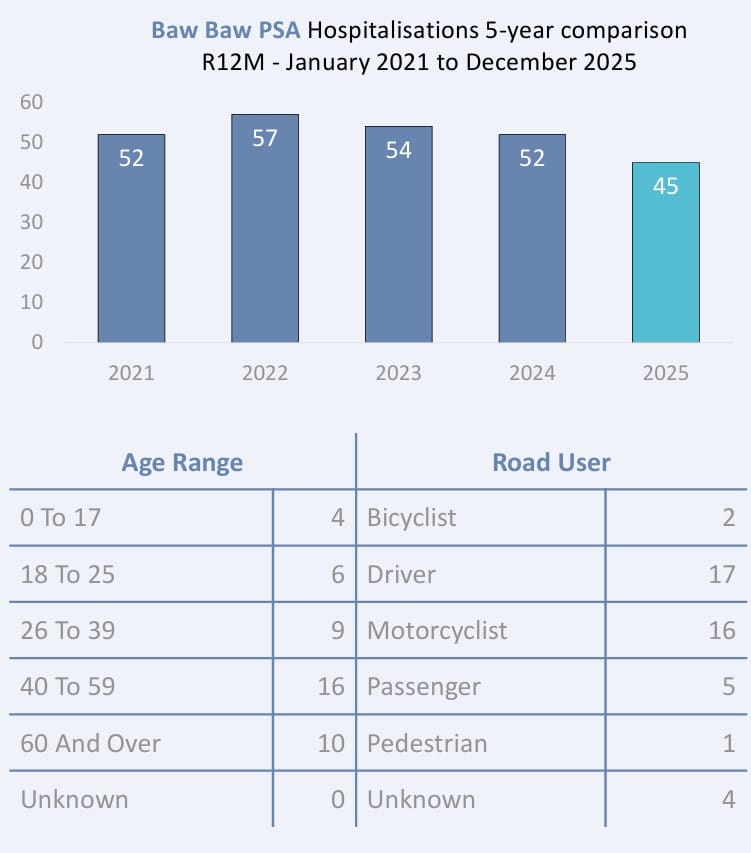
Insp Ferguson said about a quarter of fatal crashes included a combination of unlicensed drivers, self-impairment as the operator of a vehicle, and excessive speed.
"Every life lost on our roads is preventable – that's how we see it," he said.
Distraction is a growing focus, with officers noting this extended to simple everyday factors such as children in the back seat, GPS units and "too many gizmos" in modern cars were increasingly being cited in collision reports.
With Baw Baw's mix of freeways, highways and narrow country roads, police said drivers must endeavour to adjust to conditions more than they currently do, not just posted speed limits.
Insp Ferguson said rural roads with soft shoulders and potholes demanded a different driving style to metropolitan freeways, and failing to adapt was a recurring theme in crashes within the area.
School zones remain another priority. Local officers are running regular speed checks around crossings, saying their "hearts stop" at near misses involving children.
Residents raised concerns about confusing school–zone timings, and some called for New South Wales style flashing light signs so drivers knew when 40km/h limits applied.
Other community members suggested all–day 40km/h limits around schools, which police admitted needed to be a state-wide discussion working with the Transport Accident Commission and other authorities, as part of existing ongoing discussions for potential reform.
With the Princes Fwy and major freight routes running through the region, heavy vehicles continue to be a police concern.
Baw Baw police are running joint operations with the National Heavy Vehicle Regulator, VicRoads and sheriff's officers, with extra units to create a highly visible impact on the network, in blitzes targeting fatigue, loading issues, general heavy vehicle compliance, and simply reassuring communities along the local freight corridor that police are "out and about."
Another concern at the forefront of residents' minds was the current driver education model, and whether changes needed to be made. Officers outlined ongoing changes, which could potentially occur in vehicle and insurance technology.
Baw Baw police inspector Stephen Cooper spoke of models used overseas allowing insurers to track speed travelled via in-car devices or phone connection that adjusted the driver's premium depending on their on-road behaviour.
He said this type of technology was currently being explored as a possibility in Australia, while advances in driver-monitoring and autonomous trucks had been proven to avoid pedestrian collisions.
Despite improvements, police stressed they were relying on human choices.
"People see police pull someone over and think, 'Why bother for 10km/h over?" insp Ferguson said. "But it's those small acts of non–compliance that add up to lives lost."


