

Shaping the future of farming
Moving cattle to fresh pasture without leaving the house might sound unlikely, but new technology being trialled at Lardner Park is making it a reality.


by Nick Rowe
Moving cattle to fresh pasture without leaving the house might sound unlikely, but new technology being trialled at Lardner Park is making it a reality.
A herd of 90 steers is being managed using Gallagher's eShepherd virtual fencing system, which allows farmers to control grazing boundaries and monitor livestock remotely using a computer, tablet or mobile phone.
The solar-powered GPS collars worn by the cattle eliminate the need to regularly shift temporary electric fences, potentially saving farmers considerable time and labour.
The technology is being used as part of Lardner Park's annual steer trial and was recently demonstrated to Gallagher representatives and visiting producers.
Previously restricted to approved research programs, virtual fencing can be now used commercially by Victorian cattle producers under prescribed animal welfare and equipment requirements.
Gallagher's general manager of global strategy and new ventures Sarah Adams described the regulatory change as a major milestone - "this is a game-changer for Victorian cattle producers."
Ms Adams also highlighted the technology's origins in Victorian research and its potential to give livestock producers greater flexibility in managing their properties.
Lardner Park property manager Anthony Willems said the biggest advantage of eShepherd had been the time saved moving temporary fencing. Previously, Mr Willems had to physically move temporary electric fences, to provide the steers with fresh pasture.
"Historically, I've strip grazed cattle on the property, using electric fences," he said.
Now he can make those changes remotely, often early in the morning before beginning other duties. "I normally just open it up on my phone," he said.
He said the cattle appeared to have developed a routine around receiving their next allocation of pasture, and via his phone, can confirm they have moved into a new grazing area.
The ability to monitor individual steers had also proved useful. "I'm looking at my phone 20 times a day," Mr Willems said.
If an animal is separated from the herd, Mr Willems said he could identify it through the system and investigate whether there might be a problem.
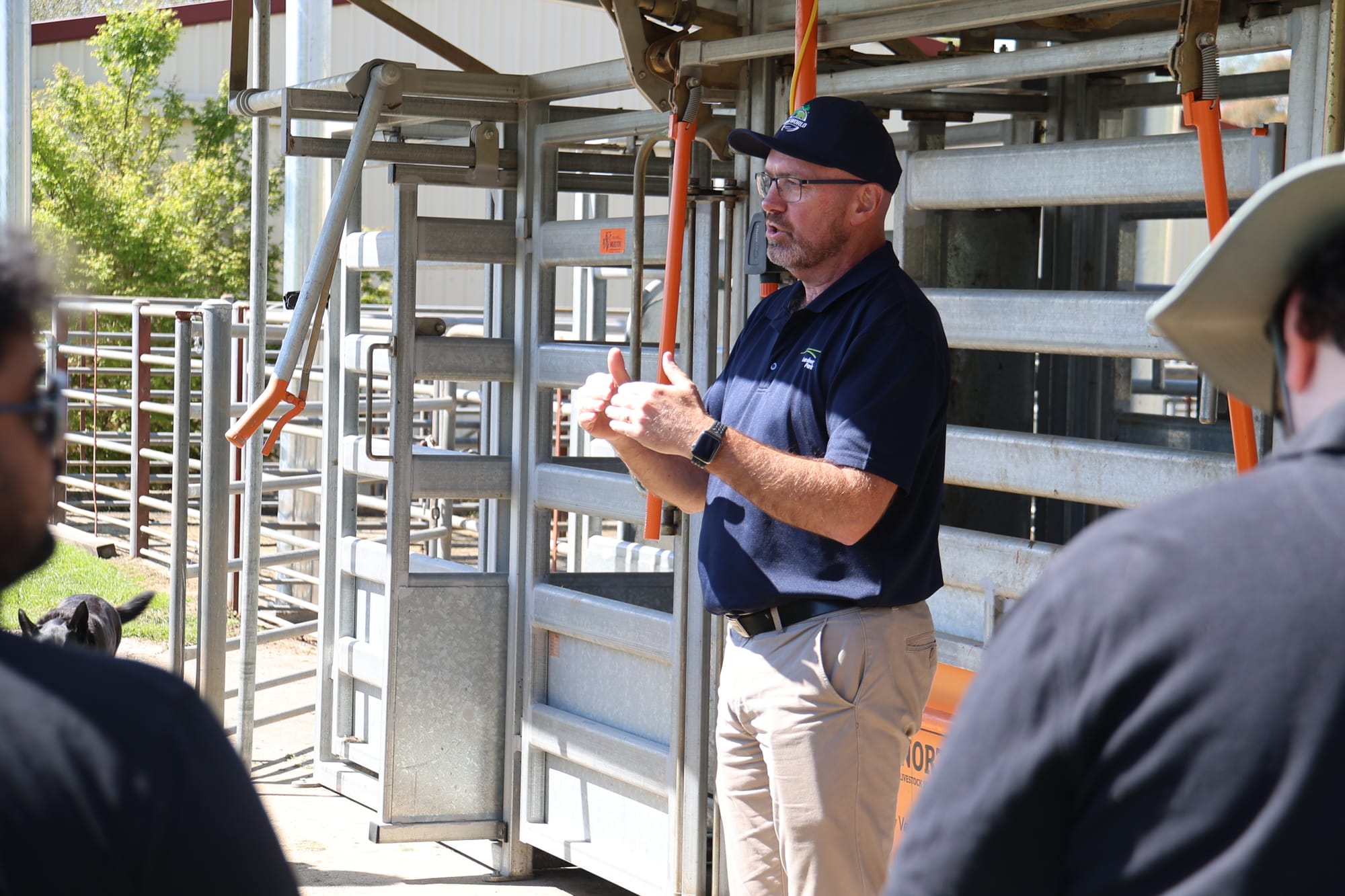
Lardner Park chief executive officer Craig Debnam said emerging agricultural technologies such as eShepherd had the potential to significantly reduce labour demands and possibly make farming more attractive to younger generations.
"We're seeing significant reductions in labour required to produce on farms these days," he said.
"For farmers used to moving cattle between paddocks or shifting temporary fences in all weather conditions, the ability to manage grazing boundaries remotely can lead to huge savings in time, effort and money."
Gallagher global customer success manager Andrew Zipson explained the technology used GPS-enabled collars to establish boundaries without conventional fencing infrastructure.
As an animal approaches a virtual boundary, its collar emits an audible warning for five seconds. If the animal turns away, no further action is taken. If it continues towards the boundary, the collar delivers an electrical pulse.
Mr Zipson said animals generally learned to associate the audible warning with the boundary relatively quickly and as a result were rarely "buzzed" by the pulse.
Mr Willems said he was seeing very few occasions where cattle received an electrical pulse. "There's very few times where I see them actually getting a pulse now," he said.
However, the demonstration also highlighted differences in the way individual animals responded.
One steer, identified as number three, regularly approached the virtual boundary, triggering audible warnings without receiving an electrical pulse. "He loves going along the virtual fence line," Mr Willems said.
Another steer, number 16, had barely approached the boundary at all.
Mr Willems said the technology had been surprisingly straightforward to learn. "I'm not that tech savvy I should say, but I picked it up in no time," he said.
He demonstrated how new grazing areas could be established on a laptop by drawing boundaries around sections of paddock.
Mr Willems said experience had helped him understand some of the practical considerations. In particular, he had learned to allow sufficient room when creating virtual lanes leading towards cattle yards and gateways.
"Creating a lane that's too tight can be a problem," he said.
The trial involves 90 steers from different producers, with cattle assessed for weight gain under grass-fed conditions.
It allows farmers to benchmark the performance of their animals against other herds and evaluate differences in genetics and productivity.
Mr Debnam said Lardner Park's varied terrain made it a useful location for demonstrating emerging agricultural technologies.
Beyond virtual fencing, Gallagher is developing technology to provide farmers with a more comprehensive picture of livestock performance and farm productivity.
Mr Zipson said the company's objective was not simply to collect more information, but to help producers make better decisions. "We don't just want to give you data because the more data I give you, the more confused you get," he said.
Gallagher's Sarah Adams also explained how monitoring cattle movements could help farmers identify potential problems with water supplies. Combining animal location information with water monitoring and other technologies could provide farmers with a clearer understanding of what was happening across their properties.
Future developments could allow producers to assess available pasture, monitor weight gains and determine when animals should be moved to new grazing areas.
For Mr Willems, the biggest change has been the ability to manage grazing without the daily task of shifting temporary fences. While the cattle still need to be checked regularly, providing them with their next allocation of fresh pasture can now be as simple as opening an app and moving a line on a screen.


